India’s system of local self-government is designed to accommodate the country’s vast diversity in settlement patterns, population density, and stages of development. From small rural villages to rapidly expanding metropolitan cities, different institutions exist to manage governance at the grassroots level. Among these institutions, the Nagar Panchayat occupies a unique and important position. It governs towns that are in transition from rural to urban status, serving as a bridge between village administration and full-fledged municipal governance.
As India continues to urbanize at a rapid pace, thousands of settlements are moving away from agriculture-based livelihoods toward commerce, services, and small-scale industry. Nagar Panchayats play a crucial role in managing this transformation by providing basic civic services, local regulation, and democratic representation during the early stages of urban development.
This article explains what a Nagar Panchayat is, its constitutional foundation, structure, functions, finances, challenges, and its importance in India’s governance system.
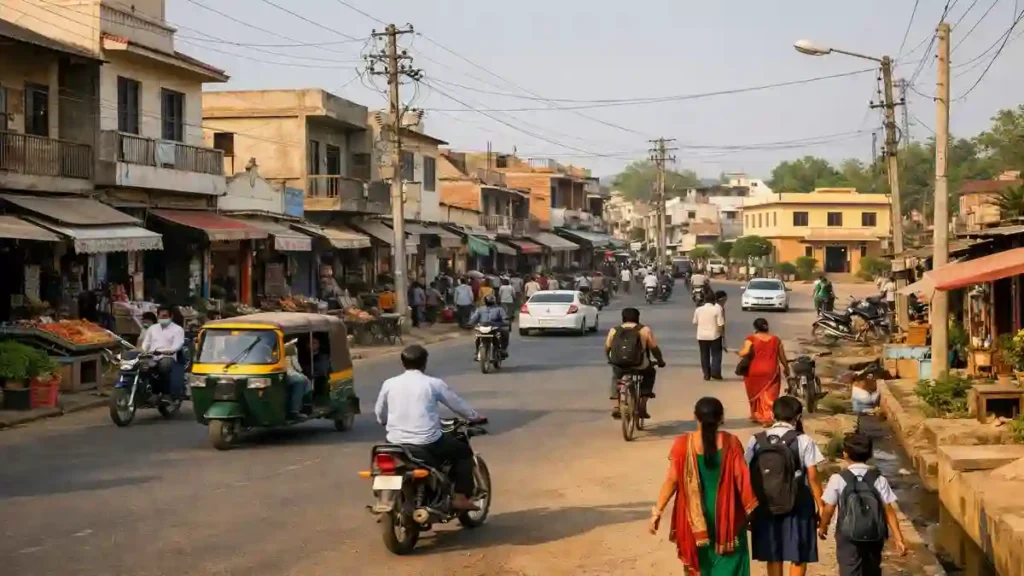
Understanding Nagar Panchayat: The Basics
A Nagar Panchayat is an urban local body constituted for a transitional area, an area that is neither fully rural nor fully urban but is gradually acquiring urban characteristics. The term “Nagar” means town, while “Panchayat” refers to a council, reflecting a hybrid institution meant to govern small but growing urban settlements.
Constitutionally, a Nagar Panchayat is distinct from other local administrative bodies such as Gram Panchayats, Municipal Councils, Municipal Corporations, or Notified Area Councils. While some states use different nomenclature under their municipal laws, the Constitution of India specifically recognizes it as a separate category of urban local body meant for transitional areas.
The concept of Nagar Panchayat gained constitutional status with the enactment of the 74th Constitutional Amendment Act, 1992. This amendment aimed to strengthen urban local governance by providing constitutional recognition, regular elections, and a framework for the devolution of powers and responsibilities to urban local bodies.
Population and Area Criteria for Formation
The Constitution does not prescribe a fixed population threshold for the creation of a Nagar Panchayat. Instead, Article 243Q leaves it to the discretion of state governments to determine whether an area qualifies as a transitional area, a smaller urban area, or a larger urban area.
In practice, most states constitute Nagar Panchayats for settlements with populations generally ranging between 10,000 and 30,000. However, population size alone is not decisive. State governments also consider several other factors, including:
• Population density
• Percentage of non-agricultural employment
• Revenue generation potential
• Economic activity and market presence
• Availability of urban infrastructure
• Administrative convenience
In hilly, tribal, or sparsely populated regions, areas with lower populations may still be notified as Nagar Panchayats. Conversely, in highly urbanized states, the population threshold may be higher. This flexible approach allows states to respond to local realities rather than applying a rigid national standard.
Constitutional Framework and Legal Basis
The constitutional foundation of Nagar Panchayats lies in Part IX-A of the Constitution of India, introduced by the 74th Constitutional Amendment Act, 1992.
Article 243Q classifies urban local bodies into three categories:
• Nagar Panchayat for transitional areas
• Municipal Council (or Municipality) for smaller urban areas
• Municipal Corporation for larger urban areas
The Constitution mandates that every urban local body must be governed by elected representatives and that elections must be held regularly. It also provides safeguards against arbitrary dissolution and ensures continuity of democratic governance.
The 12th Schedule to the Constitution lists 18 subjects that may be entrusted to urban local bodies. These include urban planning, regulation of land use, roads and bridges, water supply, public health, sanitation, fire services, slum improvement, and urban poverty alleviation. However, it is important to note that the Constitution enables these functions but does not automatically transfer them. The actual devolution of powers depends on state municipal laws.
Structure and Composition of Nagar Panchayat
A Nagar Panchayat consists of elected members, commonly referred to as councillors, who represent territorial wards within the town. The number of wards is determined by the population and area of the settlement, as provided under state municipal legislation.
Each ward elects one councillor through direct elections conducted by the State Election Commission. The tenure of this Panchayat is generally five years.
Its leadership typically includes:
• A chairperson (also called president or chairperson-in-council)
• A vice-chairperson or deputy chairperson
The method of selecting the chairperson varies across states. In some states, the chairperson is elected directly by the voters, while in others the chairperson is elected indirectly by the councillors from among themselves.
An executive officer or secretary, appointed by the state government, serves as the chief administrative authority. This officer is responsible for implementing resolutions, managing finances, supervising staff, and ensuring compliance with laws and regulations.
Reservation System in Nagar Panchayat Elections
The reservation system in Nagar Panchayat elections is designed to ensure inclusive representation of historically marginalized groups.
Seats are reserved for Scheduled Castes and Scheduled Tribes in proportion to their population in the Nagar Panchayat area. Additionally, not less than one-third of the total seats are reserved for women, including seats reserved for women belonging to Scheduled Castes and Scheduled Tribes.
Many states have enhanced women’s reservation to 50 percent through their municipal laws, going beyond the constitutional minimum. This has significantly increased women’s participation in local governance.
The office of chairperson is also subject to reservation and rotation among different categories, including Scheduled Castes, Scheduled Tribes, women, and the general category, as provided under state legislation.
Functions and Responsibilities
The functions of a Nagar Panchayat depend on the extent of powers devolved by the state government. While the 12th Schedule provides a broad functional framework, actual responsibilities may vary from state to state.
Typically, these are responsible for:
• Maintenance of local roads, drains, and street lighting
• Solid waste management and sanitation services
• Regulation of construction and issuance of building permissions
• Maintenance of public spaces, parks, and community assets
• Registration of births and deaths
• Management of local markets and regulation of street vendors
• Implementation of government welfare and poverty alleviation schemes
In sectors such as public health, education, and fire services, these administrative units usually play a supportive or coordinating role. Primary responsibility often rests with state or district authorities, while Nagar Panchayats assist with infrastructure maintenance, awareness campaigns, and local implementation.
Financial Resources and Revenue Sources
Financial capacity is a critical determinant of the effectiveness of Nagar Panchayats. Their revenue sources broadly fall into two categories: internal revenue and external transfers.
Internal revenue sources include:
• Property tax on residential and commercial buildings
• Water supply and sanitation charges
• License and permit fees for businesses and vendors
• Market fees and shop rentals
• Penalties and fines for violations of municipal regulations
External sources include:
• Grants from state governments
• Recommendations-based grants from State Finance Commissions
• Central government assistance under various schemes
• Special-purpose grants for infrastructure and sanitation
The extent of taxation powers varies widely across states, and many Panchayats remain heavily dependent on grants due to limited local revenue generation.
Decision-Making and Administrative Process
Nagar Panchayats function through regular meetings of elected members. These meetings are generally held monthly, though the frequency and quorum requirements are governed by state municipal laws.
Decisions are taken by majority vote. Committees may be constituted for specific areas such as finance, public works, health, or education to examine matters in detail and make recommendations.
The executive officer or secretary ensures the implementation of resolutions, maintains financial records, and oversees day-to-day administration.
Relationship with District and State Authorities
Although Nagar Panchayats enjoy constitutional recognition, they function within the framework of state municipal legislation. District administration provides oversight, technical assistance, and coordination, particularly for implementing state and central schemes.
Their budgets and accounts of are subject to audit, and statutory reports must be submitted to higher authorities. State governments have the power to dissolve a Nagar Panchayat under legally defined circumstances, but elections must ordinarily be held within six months, unless the remaining term is less than six months.
Challenges Faced by Nagar Panchayats
Despite their importance, Nagar Panchayats face several challenges:
• Limited financial autonomy and revenue base
• Inadequate technical and administrative capacity
• Shortage of trained staff
• Partial devolution of constitutional functions
• Rapid population growth outpacing infrastructure development
• Low levels of public awareness and participation
These challenges often constrain effective service delivery and long-term planning.
Reforms and Modernization Efforts
In recent years, efforts have been made to strengthen Nagar Panchayats through:
• Introduction of e-governance platforms
• Capacity-building programs for officials and councillors
• Performance-based grants under Finance Commission recommendations
• Urban sanitation initiatives under Swachh Bharat Mission
• Infrastructure support under state and centrally sponsored schemes
Eligibility for major programs such as AMRUT or Smart Cities depends on state selection and specific criteria, and not all Nagar Panchayats are covered.
Importance in India’s Governance System
Nagar Panchayats play a crucial role in managing India’s urban transition. They provide an institutional framework for early urban governance, ensure democratic participation, and facilitate orderly development.
They also serve as training grounds for political leadership and foster grassroots democracy by bringing governance closer to citizens.
Conclusion
Nagar Panchayats occupy a vital position in India’s system of urban local governance. Established under the 74th Constitutional Amendment, they are designed to manage transitional towns by providing essential civic services and democratic representation. While challenges related to finance, capacity, and autonomy remain, ongoing reforms continue to strengthen these institutions. As India urbanizes further, empowering Nagar Panchayats with adequate resources, authority, and technical support will be essential for sustainable and inclusive urban development.
Also Read: Census Town vs Statutory Town