India is a country of contrasts. On one side, you have sprawling megacities like Mumbai, Delhi, and Bengaluru buzzing with corporate offices, tech parks, and industrial zones. On the other side, you have thousands of small towns where life moves at a different pace and employment looks completely different. Understanding employment patterns in Indian towns compared to cities is important for policymakers, job seekers, and researchers who want to get a clearer picture of how India’s workforce actually functions.
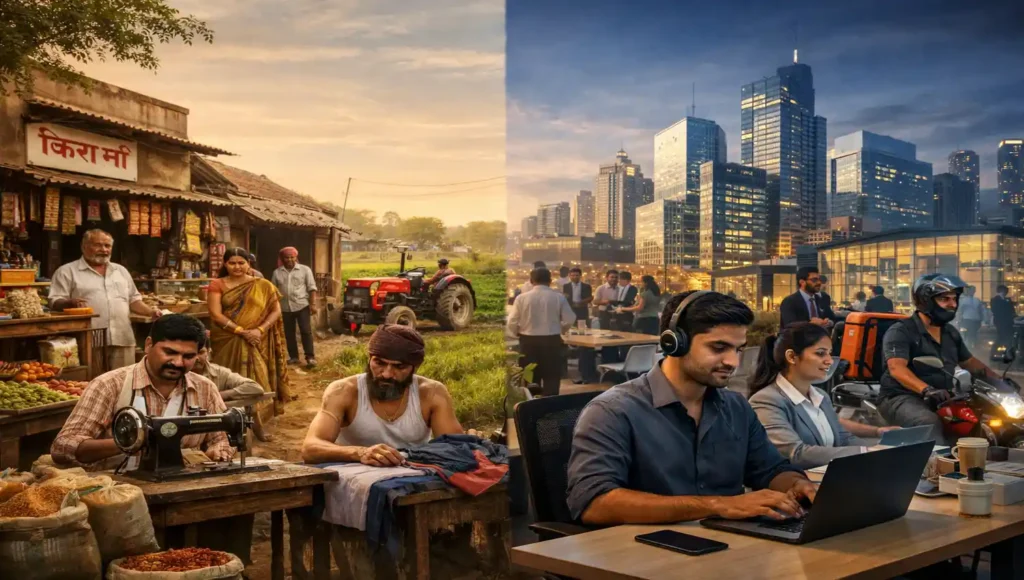
How Employment Looks in Indian Cities
Indian cities account for a larger share of formal employment compared to towns and rural areas, though informal work still dominates even within urban boundaries. Metropolitan areas attract large-scale industries, multinational companies, government offices, and service sector enterprises. Cities like Pune, Hyderabad, and Chennai have become hubs for information technology, manufacturing, and finance, creating a dense concentration of salaried positions with fixed working hours, provident fund benefits, and written contracts.
In cities, employment patterns are heavily skewed toward the tertiary sector, which includes retail, banking, education, healthcare, hospitality, and professional services. According to the Periodic Labour Force Survey 2022-23, urban areas show significantly higher rates of regular wage and salaried employment, with approximately 50 percent of urban workers engaged in regular wage work compared to much lower rates in rural and semi-urban areas. Workers in cities are more likely to receive monthly salaries, social security coverage, and structured career advancement opportunities.
The informal economy in cities remains massive, accounting for roughly 65 to 75 percent of even the urban workforce. Street vendors, domestic workers, construction laborers, auto-rickshaw drivers, and small shop owners make up a substantial portion of city workers. These workers operate outside formal employment frameworks but are embedded in a fast-moving urban economic environment that offers relatively more earning opportunities than smaller settlements.
Employment Patterns in Indian Towns
When we talk about employment patterns in Indian towns, we are referring to semi-urban settlements that sit between rural villages and large cities. These include notified areas, municipal towns, census towns, and smaller district headquarters, typically with populations ranging from ten thousand to a few hundred thousand people.
Employment in Indian towns is more diverse than many people assume. While agriculture remains a fallback for residents on the outskirts, the core town economy often revolves around trade, small manufacturing, local government jobs, teaching positions, and services like repairs, transport, and retail. Many towns are home to government-run schools, district hospitals, sub-divisional offices, and police stations, which create a steady if limited pool of public sector jobs.
One defining feature of employment patterns in Indian towns is the high rate of self-employment. According to PLFS data, self-employment rates in semi-urban and small-town settings are considerably higher than in large cities. However, this self-employment is largely necessity-driven rather than opportunity-based. Most people run small businesses not because of entrepreneurial ambition but because formal job opportunities simply are not available. A grocery store, a tailoring shop, or a small transport service often represents the only viable livelihood option rather than a deliberate business choice.
Key Differences in Employment Patterns Between Towns and Cities
Nature of Work and Sector Distribution
The most visible difference in employment patterns in Indian towns compared to cities is the type of work people do. City workers are more concentrated in formal services, manufacturing, and technology. Town workers are spread across informal trade, government services, small-scale production, and agriculture-linked activities.
In cities, you find workers in specialized roles: software developers, financial analysts, logistics managers, and hospital administrators. In towns, the same family might have one member working as a government teacher, another running a small hardware shop, and a third doing agricultural labor during harvest season. This diversified, mixed-income structure is a hallmark of town-level employment patterns.
Income Levels and Wage Gaps
The income gap between town and city employment is significant and well-documented. PLFS data consistently shows that average monthly earnings for regular salaried workers in urban metros are considerably higher than what comparable workers earn in small towns. This wage gap remains one of the primary drivers of large-scale migration from towns to cities.
Lower living costs in towns partially offset lower wages, but do not eliminate the income gap. Housing, food, transportation, and education in small towns cost a fraction of what they do in major cities. Still, the lack of high-paying job opportunities remains the biggest structural challenge pushing educated young people from towns toward city employment.
Formal Versus Informal Employment
Employment patterns in Indian towns compared to cities show a clear contrast in formality. Cities have a relatively higher share of formal employment compared to towns, though informal work still constitutes the majority of the workforce even in large metros. Over 75 percent of India’s total workforce, across both urban and rural settings, operates informally without written contracts, statutory benefits, or social security coverage.
In towns, formal employment is largely limited to government jobs, bank branches, and a few organized retail or manufacturing units. The gig economy has expanded rapidly in cities, with platforms like Swiggy, Zomato, Ola, and Urban Company creating large-scale semi-formal employment opportunities, a phenomenon that has barely touched most small towns.
Gender and Employment Participation
Employment patterns across towns and cities in India also differ significantly by gender, though the picture is more nuanced than it first appears. Urban areas show higher participation among women in formal and salaried roles, particularly in sectors like IT, education, healthcare, and organized retail. However, overall female labour force participation is often higher in rural areas than in urban settings, because rural women contribute substantially to agricultural work and unpaid household-based production that gets counted in labour surveys.
In Indian towns, women’s participation in the formal economy remains limited. Cultural norms, inadequate childcare infrastructure, safety concerns during commutes, and fewer suitable formal job opportunities all contribute to lower measured female employment in small-town settings. Women in towns more commonly contribute through household-based enterprises, informal trade, or support roles in family businesses without receiving counted wages.
The Role of Government Jobs in Town Employment
One category that carries exceptional weight in employment patterns in Indian towns is government employment. For many families in small towns, securing a government position, whether as a teacher, a revenue official, a constable, or a bank clerk, is considered the most desirable employment outcome. Government jobs offer security, pension benefits, and social prestige that private sector work in small towns cannot match.
Competition for government jobs in small towns is intense. Coaching centers preparing students for civil service exams, police recruitment tests, and banking exams have become a significant industry in themselves across hundreds of Indian towns. Cities like Allahabad, Patna, and Jaipur serve as coaching hubs precisely because they draw aspirants from smaller towns across entire regions.
Migration as a Response to Employment Gaps
The structural gap in employment patterns between Indian towns and cities has fueled one of the world’s largest internal migration flows. Workers move from towns and villages to cities in search of better wages and more stable employment. This movement is both seasonal and permanent. Construction workers, domestic helpers, factory hands, and informal traders migrate from smaller towns to big cities and send remittances back home, supporting local consumption and improving household incomes in their places of origin.
Cities absorb cheap labor that keeps many industries running, while towns lose a portion of their most economically active population. The COVID-19 pandemic caused a significant, if temporary, reversal in this pattern. Millions of migrant workers returned to their home towns during lockdowns, and some stayed on, either setting up small businesses or finding local employment, revealing both the fragility of city-based informal employment and the underlying resilience of small-town economies.
Emerging Changes in Town Employment Patterns
The employment landscape in Indian towns is not static. Digital connectivity has opened new possibilities for semi-urban workers. Freelancers in small towns now work for clients across the country and internationally. E-commerce has enabled small traders in towns to reach wider markets. Online tutoring, digital marketing, and remote software work are creating new employment categories that were unthinkable a decade ago.
Government schemes including the PM Rozgar Protsahan Yojana, Skill India, and MSME development programs have tried to stimulate employment creation in smaller towns. Industrial corridors and new special economic zones have been designed to shift some manufacturing activity away from large metros toward smaller cities and towns, though implementation remains uneven.
A Quick Comparison: Towns vs Cities
| Factor | Cities | Towns |
|---|---|---|
| Formal Employment | Relatively higher | Relatively lower |
| Self-employment | Lower | Higher (necessity-driven) |
| Average Income | Higher | Lower |
| Cost of Living | High | Low |
| Gig Economy Presence | Significant | Minimal |
| Government Job Dependence | Moderate | High |
| Female Formal Participation | Higher | Lower |
What These Employment Patterns Mean for India’s Future
Understanding employment patterns in Indian towns compared to cities is not just an academic exercise. It has direct implications for policy, investment, and social planning. According to PLFS 2022-23, urban employment conditions are improving gradually, but the gap between town and city employment quality remains wide and persistent.
If India is to create meaningful employment for its growing working-age population, cities alone cannot absorb everyone. Strengthening employment opportunities in small towns, improving infrastructure, expanding formal sector presence, and supporting local entrepreneurship are all essential steps. A more balanced distribution of employment across towns and cities would reduce inequality, ease urban congestion, and improve the quality of life for millions of Indians currently caught between a local economy that cannot fully support them and cities that remain out of reach.
Employment patterns in Indian towns and cities reflect the broader complexity of India’s workforce. Each layer, from the street vendor in a small-town market to the software engineer in a Bengaluru tech park, is part of the same national economic story, just living very different chapters of it.