Talwandi Sabo is a small but historically significant city located in the Bathinda district of Punjab, India. It sits in the southwestern part of the state, in a region that has long been part of the cultural and agricultural heartland of Punjab. Despite its modest size, Talwandi Sabo carries enormous importance in the religious world, particularly for the Sikh community across the globe. The city is home to one of the most revered Sikh shrines in India, and this single fact has shaped everything about how the city has grown, what it means to people, and why visitors travel from distant parts of the world to reach it.
The city is also known by another name, Damdama Sahib, which is the name of the historic Gurdwara located here. Over time, many people informally use both names interchangeably, though Talwandi Sabo remains the official administrative name. The town serves as the headquarters of Talwandi Sabo tehsil, which is one of the administrative subdivisions of Bathinda district.
Location and Geography of Talwandi Sabo
Talwandi Sabo lies in the flat plains of southwestern Punjab. The terrain around the city is largely agricultural, with vast stretches of farmland surrounding the urban area. The region falls within the Malwa belt of Punjab, which is the area south of the Sutlej river. Malwa is one of the three cultural and geographic zones of Punjab, and it has its own distinct dialect, customs, and traditions that set it apart from the Majha and Doaba regions.
The city is connected to Bathinda, the district headquarters, by road. Bathinda itself is a major city in the region with railway connectivity and urban infrastructure, making it the nearest large urban center for people living in this town. The distance between the two towns is approximately 28 kilometers, making travel between them easy and accessible for daily commuters and visitors alike.
The surrounding landscape is dominated by wheat and cotton fields, two of the most important crops grown in this part of Punjab. The region receives moderate rainfall and depends significantly on canal irrigation systems that have historically made agriculture viable in this otherwise semi-arid zone.
Historical Background
The history of Talwandi Sabo stretches back several centuries. Before it became famous for its association with Sikhism, the town existed as a settlement in the Malwa region with its own local character. The name Talwandi itself appears in various forms across Punjab, most famously in Nankana Sahib in present-day Pakistan, which was historically called Talwandi and is the birthplace of Guru Nanak Dev Ji, the founder of Sikhism.
The town rose to historical prominence primarily because of its connection to Guru Gobind Singh Ji, the tenth and last human Guru of the Sikhs. He arrived here in 1706 after a period of great hardship and military conflict with the Mughal forces. His time spent in this town became one of the most important episodes in Sikh religious history, and it transformed Talwandi Sabo from an ordinary settlement into a place of deep spiritual meaning.
Damdama Sahib and Its Sikh Significance
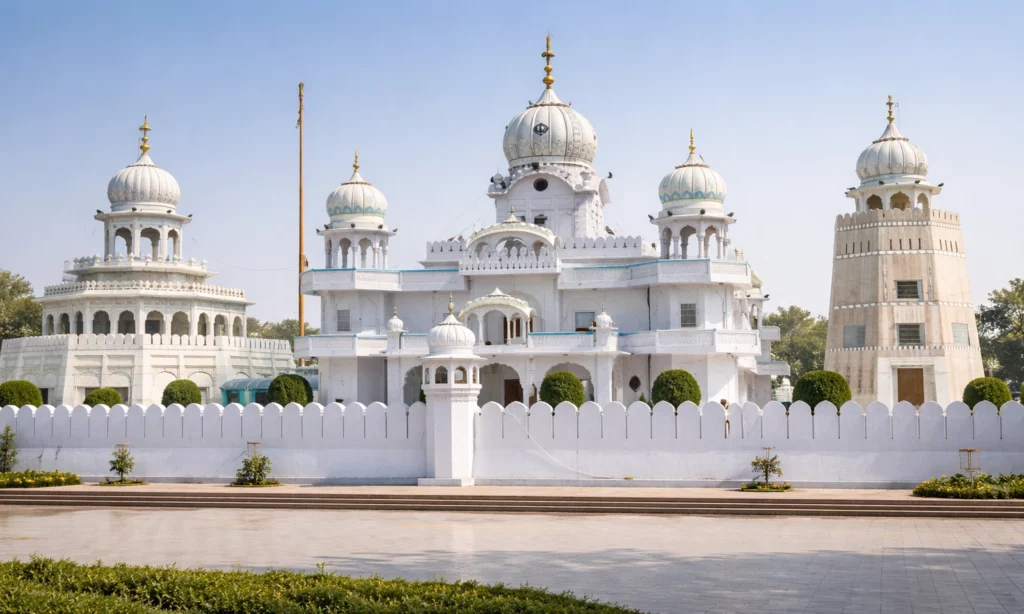
The Gurdwara Damdama Sahib is the defining landmark of Talwandi Sabo and one of the five Takhts of Sikhism. A Takht, meaning throne in Punjabi, is a seat of temporal and spiritual authority in the Sikh faith. There are five Takhts in total, and Damdama Sahib holds the distinction of being one of them, placing this town among the most sacred destinations in the Sikh world alongside Amritsar, Anandpur Sahib, Patna Sahib, and Nanded.
Guru Gobind Singh Ji spent approximately nine months at this location. During this stay, he dictated the complete version of the Guru Granth Sahib, the holy scripture of Sikhism, from memory. This monumental act gave Damdama Sahib the title of Gur Ki Kashi, meaning the Kashi of the Guru, a reference to Varanasi as a great center of learning. The Guru recited the entire scripture to Bhai Mani Singh, who transcribed it, and this final version became the definitive edition of the Guru Granth Sahib that Sikhs revere today.
Because of this event, Damdama Sahib became known as a center of Sikh scholarship and learning. Many Sikhs consider it a place where not just the body but the mind and spirit come to be nourished. The Gurdwara complex today is large and well maintained, drawing thousands of pilgrims every month from across India and from Sikh communities settled abroad in countries like Canada, the United Kingdom, and the United States.
Religious Festivals and Gatherings in Talwandi Sabo
Talwandi Sabo comes alive during religious festivals, particularly those that hold special significance in the Sikh calendar. Gurpurabs, which are anniversaries marking important events in the lives of the Sikh Gurus, draw enormous crowds to the Damdama Sahib complex. The Gurpurab of Guru Gobind Singh Ji is especially celebrated here with great devotion, given the Guru’s personal and historic connection to this place.
Baisakhi, celebrated in April each year, is another major occasion when pilgrims gather in large numbers. Baisakhi holds deep religious meaning for Sikhs as it marks the founding of the Khalsa in 1699 by Guru Gobind Singh Ji. Though the Khalsa was founded at Anandpur Sahib, the celebrations at Damdama Sahib draw significant participation because of the Guru’s later connection to Talwandi Sabo.
During these festivals, the town transforms into a busy pilgrimage center with langars, which are community kitchens serving free meals to all visitors regardless of their religion or background. The tradition of langar is central to Sikhism and reflects its core values of equality and service. At Damdama Sahib, langar operates continuously throughout the year and reaches its fullest expression during major festivals.
Education and the Legacy of Learning
One of the lasting legacies of Guru Gobind Singh Ji’s stay at Talwandi Sabo is the association of this town with education and scholarship. The Guru himself encouraged learning during his time here and the town developed a reputation as a center of Sikh intellectual activity. This spirit has carried forward into the modern era.
This city today has educational institutions serving the local population and the surrounding rural areas. Schools and colleges in the town provide access to education for students from the many villages that fall within the tehsil. The presence of the Gurdwara and the religious tourism it generates has also contributed to a degree of economic activity that supports the growth of local infrastructure including educational facilities.
Administration and Civic Life
Talwandi Sabo functions as the headquarters of its tehsil, which means it houses the administrative offices responsible for land records, revenue matters, and local governance for the surrounding area. The tehsil falls under Bathinda district, and district-level administrative functions are handled from Bathinda city.
The town has a municipal council that manages civic affairs including local roads, sanitation, water supply, and public spaces. Like many small towns in Punjab, it faces the common challenges of managing urban growth while maintaining infrastructure. The flow of pilgrims throughout the year places additional demands on civic services, and the administration works alongside the Shiromani Gurdwara Parbandhak Committee, which manages the Damdama Sahib complex, to ensure that the town functions smoothly during peak pilgrimage seasons.
Economy and Livelihoods
Its economy rests on two main pillars: agriculture and religious tourism. The surrounding tehsil is predominantly rural, with farming communities growing wheat, cotton, and other crops typical of the Malwa region. Many residents of the town are engaged in trade and services that support both the local farming population and the steady stream of pilgrims who visit the Gurdwara.
Small businesses, shops, dhabas, and accommodation facilities have grown around the Gurdwara complex to serve visitors. Pilgrims who travel long distances often stay for a day or more, creating demand for food, lodging, and transport services. This religious economy forms a meaningful part of the town’s commercial life.
Agriculture in the surrounding villages benefits from the canal network that irrigates much of southwestern Punjab. Farmers here have traditionally grown cotton as a cash crop, contributing to the broader economy of the Malwa region which is sometimes called the cotton belt of Punjab.
Demographics and Population of Talwandi Sabo
Talwandi Sabo is a predominantly Sikh town, reflecting the broader demographic character of rural Punjab in this region. The population speaks Punjabi and the local dialect carries the distinct flavor of Malwai Punjabi, which differs somewhat in pronunciation and vocabulary from the Punjabi spoken in other parts of the state.
The town’s population is modest compared to major urban centers but has grown steadily over the decades as improved connectivity, educational facilities, and the economic activity generated by pilgrimage have attracted people from surrounding villages. The 2011 Census of India recorded Talwandi Sabo as a town with its own civic body, reflecting its status as an urban settlement within the largely rural tehsil.
Connectivity and Access
Reaching at this town is straightforward for most travelers coming from within Punjab. The town is accessible by road from Bathinda, which is the nearest railway junction. Bathinda has rail connections to major cities including Delhi, Amritsar, and Chandigarh, making it the natural entry point for pilgrims arriving from outside Punjab.
From Bathinda, buses and taxis cover the approximately 28-kilometer distance to Talwandi Sabo with regularity. The road passes through agricultural countryside and connects several smaller villages along the route. For pilgrims arriving from outside India, the nearest major airports are in Amritsar and Chandigarh, both of which have road connections to Bathinda and onward to Talwandi Sabo.
Cultural Identity and Community Life
The cultural identity of Talwandi Sabo is inseparable from its religious heritage. The presence of Damdama Sahib shapes the rhythm of daily life in the town. The sound of kirtan, which is devotional music and singing from the Guru Granth Sahib, rises from the Gurdwara at all hours, and the atmosphere of the town carries a quality of quiet devotion that pilgrims often remark upon.
Community life in this area reflects broader Punjabi values of hospitality, hard work, and religious observance. The people of the town take pride in their role as custodians of one of Sikhism’s most sacred sites. Local families have for generations been involved in the service of the Gurdwara and in welcoming pilgrims who arrive seeking spiritual solace.