India is a land of stories. Every region carries its own dialect, its own food, its own festivals, and its own way of life. But as the country grows rapidly, a quiet cultural erosion is happening in its major cities. Mumbai, Delhi, Bangalore, and Hyderabad are becoming increasingly similar, shaped by global trends, migration, and commercial pressures. Meanwhile, Indian towns continue to hold the fabric of local culture together in ways that cities simply cannot.
The Cultural Gap Between Indian Towns and Cities
The difference between an Indian town and a large city is not just about population size. It is about pace, priorities, and identity. In cities, rapid urbanization pushes people toward uniformity. People adopt similar clothing styles, eat at the same fast food chains, and gradually lose touch with regional customs. The pressure to blend in with a cosmopolitan crowd often means leaving behind the traditions of one’s ancestral home.
Indian towns, by contrast, move at a slower pace. The local identity is not just a memory here. It is an active, living part of daily life. Whether it is the way people greet each other, the spices used in the kitchen, or the specific form of folk music played at weddings, small towns carry these details forward with pride and consistency.
This cultural continuity in Indian towns is not accidental. It is rooted in community structures, economic patterns, and a deep attachment to place that urban migration tends to dissolve.
Language and Dialect Are Alive in Indian Towns
One of the clearest signs of how Indian towns preserve local culture is through language. In cities like Bangalore or Pune, you are more likely to hear Hindi or English in public spaces than Kannada or Marathi. The working population in major cities comes from all over the country, and a common language becomes necessary for daily communication.
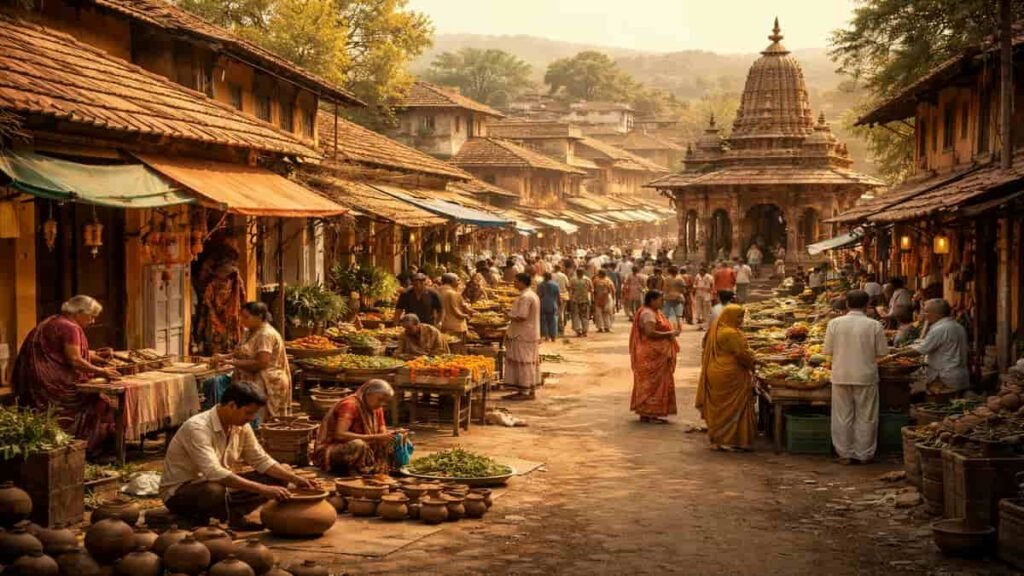
In smaller towns, however, the regional language is not just spoken at home. It is used in markets, schools, government offices, and social gatherings. Local dialects and idioms remain vibrant and are passed naturally from one generation to the next. A teenager in a small town in Rajasthan or Odisha is far more likely to speak fluent regional dialect than their city counterpart who has grown up watching national television and attending English-medium schools.
This linguistic richness is a core part of how regional centers outshine metros in cultural retention. Language carries history, values, and community identity within it. When a dialect fades, a way of seeing the world disappears with it.
Festivals and Traditions Remain Community Events
Visit a large Indian city during a major festival and you will notice something interesting. The celebrations happen, but they are increasingly commercial, organized, or contained within apartment buildings. In many urban neighborhoods, people do not even know the names of their neighbors.
In Indian towns, festivals are still community events in the fullest sense of the word. Dussehra in Kullu, Bihu in Assam’s smaller towns, Pongal celebrations in Tamil Nadu’s rural districts, or the Ganesh processions in smaller Maharashtra towns involve entire neighborhoods working together. Preparations start weeks in advance. Everyone plays a role, from the elderly who teach rituals to children who learn by participating.
This communal participation is how Indian towns preserve local culture from generation to generation. The knowledge is not stored in books. It is passed through practice, through watching, through doing. A child who helps set up the stage for a local Ram Leela will carry that experience for a lifetime in a way that watching a performance on television never achieves.
Traditional Crafts and Art Forms Survive in Small Towns
India has hundreds of traditional crafts, each tied to a specific region. Madhubani painting from Bihar, Warli art from Maharashtra, Pattachitra from Odisha, block printing from Rajasthan, and weaving traditions from Varanasi are just a few examples. These crafts are not just decorative. They represent entire communities, their stories, their spirituality, and their economic identity.
Cities do consume these crafts, but mostly as products. The artisans who create them mostly live in smaller towns and villages. The craft traditions are nurtured in places where they were born, where the community understands their meaning, and where the techniques are taught informally within families and neighborhoods.
This is another important way towns preserve local culture and traditions. Craft knowledge in these communities is not archived. It is active. Young people grow up watching their parents and grandparents work, and many choose to continue the tradition because it is deeply connected to who they are.
When government programs or NGOs try to revive dying crafts, they almost always return to these towns and small communities because that is where the living memory of the craft exists.
Local Food Culture Stays Intact in Indian Towns
Food is one of the most intimate expressions of culture. India has extraordinary culinary diversity, with each district, sometimes each village, having its own recipes, cooking methods, and seasonal food practices.
In large cities, this diversity gets flattened. Restaurants serve standardized versions of regional dishes adapted for broader tastes. Home cooking in urban apartments increasingly relies on packaged ingredients. The original techniques, the use of locally sourced spices, the knowledge of which wild greens to pick in summer, all of this gets lost in the urban transition.
In Indian towns, local food culture stays considerably more intact. Street vendors still sell region-specific snacks that you will not find in city restaurants. Home kitchens still use traditional recipes passed down through families. Local markets still supply seasonal and regional ingredients that supermarkets in cities have replaced with standardized goods.
Religious Practices and Community Shrines Hold Communities Together
India’s religious landscape is immensely complex, with layers of local belief systems sitting alongside the major religions. Every town and village has its own patron deity, its own specific form of worship, and its own calendar of ritual events. These hyperlocal religious practices are not widely documented or celebrated in national media, but they are extraordinarily rich.
In cities, religion often becomes private or is practiced in standardized temple or mosque settings. The local flavor of worship, the community shrine at the edge of a neighborhood, the annual pilgrimage specific to a particular caste or community, these tend to disappear or get absorbed into more generic religious practice in urban environments.
Indian towns maintain these local religious traditions with remarkable consistency. The small shrine dedicated to a local folk deity at the edge of town is cleaned and decorated every week. The annual fair tied to a local saint’s death anniversary draws the whole community together. These practices show how Indian towns preserve local culture at its most grassroots level.
The Role of Community Elders in Cultural Transmission
In Indian towns, elders occupy a social role that has largely been eroded in cities. They are not just senior family members. They are living libraries of local knowledge, traditional practices, oral histories, and cultural wisdom. In a town setting, their authority in cultural matters is respected and consulted.
Urban migration breaks this structure. Young people move to cities for education and work, and the connection with family elders weakens. The knowledge those elders hold does not transfer as naturally because the daily proximity and shared life context no longer exists.
This is one of the structural reasons Indian towns are better at preserving local culture. The multigenerational household and the community elder remain socially relevant in ways that city life makes increasingly difficult to maintain.
Why Urban India Needs Indian Towns to Stay Culturally Strong
It might seem like the cultural wealth of Indian towns is a separate matter from city life, but the two are deeply connected. Cities draw their cultural color from the towns and regions their migrant populations come from. The Bhojpuri music heard in Delhi autos, the Chettinad restaurants in Chennai, the Durga Puja pandals built by Bengali communities in Kolkata, all of these are expressions of small town and regional culture surviving in an urban setting. If the towns stop being cultural custodians, cities will eventually lose even these threads of diversity. The cultural output of Indian towns feeds the imagination and identity of the entire nation.