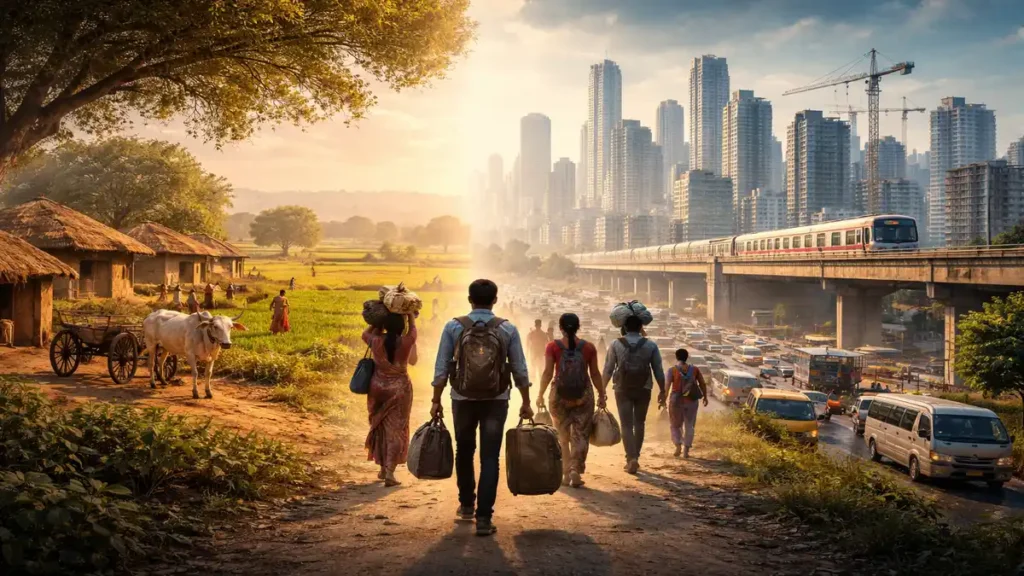
India is a country of villages. Even today, about two-thirds of its population, around 63%, lives in rural areas. But this is slowly changing. Every year, millions of people leave their villages and move to towns and cities in search of a better life. This movement, known as rural-to-urban migration, is one of the most important demographic shifts shaping modern India.
Understanding why people migrate from villages to towns, and what happens as a result, is important for students, researchers, policymakers, and anyone who wants to understand how India is changing.
What Is Rural-to-Urban Migration?
Rural-to-urban migration means moving from a village or countryside area to a town or city, either permanently or for a long period of time. In India, this type of migration is the most common form of internal movement. According to National Sample Survey Organisation (NSSO) data, rural-to-urban migration accounts for around one-quarter of all internal migration in India.
As per the Migration in India (2020–21) survey, 28.9% of Indians, approximately 400 million people, are migrants. Among people currently living in urban areas, the migration rate was about 34.9%, meaning more than one in three urban residents had moved from somewhere else, mostly from villages and small towns. These numbers show just how massive this movement is.
Why Do People Leave Villages? The Push Factors
Push factors are the conditions in rural areas that force or encourage people to move out.
1. Lack of Employment Opportunities
Agriculture is the backbone of village life in India. However, farming alone cannot support growing rural populations. The agricultural sector supports the livelihoods of around 42% of India’s workforce, yet contributes only about 18% of GDP. This means millions of farmers are working hard but earning very little.
Seasonal nature of farming makes the problem worse. Farmers may work for only a few months in a year. Outside of the harvest season, there is little or no work in many villages. Without non-farm jobs in rural areas, people are left with no choice but to move.
2. Poverty and Low Income
Rural poverty is still widespread in India. Poor soil quality, lack of irrigation, high input costs, and low market prices for crops have pushed many farming families into debt. Prolonged use of fertilizers and hybrid seeds has also led to a decline in land fertility in several states. For families struggling to make ends meet, moving to a city can feel like the only way out.
3. Poor Infrastructure in Villages
Many Indian villages still lack proper roads, electricity, clean drinking water, and quality schools. Healthcare facilities in rural areas are often inadequate. When a family member falls seriously ill, villagers may have to travel hours to reach a hospital. Poor infrastructure makes daily life difficult and pushes people to search for better-serviced locations.
4. Climate Change and Natural Disasters
Droughts, floods, and unpredictable rainfall have become more common in many parts of India. Farmers who depend entirely on rain-fed agriculture are hit the hardest. Repeated crop failures due to bad weather can wipe out a family’s savings in a single season, leaving migration as the only realistic option.
5. Social Factors
Rigid social structures, caste-based discrimination, and lack of social mobility also push people, especially from marginalized communities, out of villages. Young people in particular want to escape traditional social constraints and live more freely.
Why Do Towns and Cities Attract Migrants? The Pull Factors
Pull factors are the conditions in urban areas that attract people.
1. Better Employment and Higher Wages
Cities and towns have a wide variety of industries, construction, manufacturing, retail, IT, hospitality, and services. Even unskilled workers can find daily wage work in cities that pays significantly more than what they would earn in a village. Income outcomes for migrants are mixed, many do not see higher earnings immediately, especially after accounting for the higher cost of living in cities, but the long-term wage potential in urban areas is generally better than in agriculture-dependent villages.
2. Access to Education
Cities have more schools, colleges, and universities than rural areas. Parents move to urban areas to give their children access to better education. Young people themselves migrate to attend colleges or vocational training centers that simply do not exist in their villages.
3. Better Healthcare
Urban hospitals and clinics offer specialized care that is rarely available in rural health centers. Access to doctors, diagnostic labs, and emergency services is far better in cities. This is a major pull factor, especially for families with elderly or chronically ill members.
4. Social Networks and Information
Once a few people from a village move to a particular city, they tend to help others from the same community follow. These social networks reduce the fear and uncertainty of migration. A newcomer can rely on relatives or neighbors already living in the city for housing, job leads, and guidance. This “network effect” has made migration self-reinforcing in many communities.
5. Aspiration for a Modern Lifestyle
Exposure to television, smartphones, and the internet has shown rural youth how people in cities live. Aspirations for better clothes, food, entertainment, and social status also drive young people toward urban areas.
Who Migrates from Villages to Towns & Cities? A Look at the Data
The pattern of migration in India shows some interesting trends. According to PLFS data from 2020–21, women migrate more than men in terms of raw numbers, 47.9% of women had migrated compared to 10.7% of men. However, the reasons are very different. Most women migrate due to marriage (patrilocal customs), while most men migrate for work-related reasons.
Among work migrants, young men from states like Bihar, Uttar Pradesh, Rajasthan, and Madhya Pradesh dominate the streams moving toward cities like Mumbai, Delhi, Surat, and Bengaluru. According to 2011 Census-based studies, Maharashtra, Delhi, and West Bengal together accounted for about 44% of total inter-state migrants in the country.
Most migration in India is also local rather than long-distance, about 87% of migration is within the same state. However, among those who migrate specifically for work, about four in ten cross state borders.
Impact of Migration from Villages to Cities, on Urban Areas
1. Rapid and Unplanned Urbanization
India’s urban population is growing rapidly. According to the Economic Survey 2023–24, over 40% of India’s population is expected to live in urban areas by 2030. While urbanization itself is a sign of development, the speed and unplanned nature of India’s urban growth creates serious problems.
The number of towns in India grew from 5,161 in 2001 to 7,935 in 2011, an increase of nearly 2,800 towns in a single decade. As more people pour into cities, urban planners struggle to keep up with the demand for housing, roads, water supply, and sanitation.
2. Growth of Slums
One of the most visible consequences of rapid rural-to-urban migration is the growth of slums. According to the 2011 Census, approximately 65 million people in India lived in slums. Slums are found in 65% of Indian towns.
Migrants who arrive in cities with little money are forced to live in informal settlements, areas without legal land ownership, clean water, proper sanitation, or electricity. Places like Dharavi in Mumbai and Govindpuri in Delhi are examples of massive slum communities that have grown from this migration.
3. Pressure on Urban Infrastructure
The influx of migrants puts tremendous pressure on existing urban infrastructure. Roads become congested, public transport gets overcrowded, water supply runs short, and waste management systems break down. Many cities cannot provide enough affordable housing, leading to higher rents and displacement of low-income residents.
4. Labour Supply for Industry
Not all impacts are negative. Migrants provide a large pool of affordable labour that powers India’s construction, manufacturing, and service industries. Factories, building sites, restaurants, households as domestic workers, auto-rickshaws, migrant workers keep cities running. Without them, the urban economy would slow down significantly.
5. Cultural Diversity
Cities that absorb migrants from different states and regions become culturally rich. Food, language, festivals, and traditions from across India blend together in major cities, creating a vibrant, diverse urban culture.
Impact of Migration on Rural Areas
1. Loss of Working-Age Population
When young and able-bodied people leave villages, rural areas are left with older residents and women to do the farming. This has led to what researchers call the “feminisation of agriculture,” where women increasingly take on the role of primary farmers without adequate support, training, or land rights.
2. Remittances Boost Rural Income
On the positive side, migrants send money home, these are called remittances. This money helps rural families pay for food, education, medical bills, and home improvements. In many villages, remittances from city-based relatives are the primary source of income.
3. Labour Shortages in Agriculture
As rural youth migrate to cities, villages face a shortage of agricultural labour, particularly during sowing and harvest seasons. This has pushed up rural wages in some areas, but it has also left crops unharvested in others.
4. Land Left Uncultivated
When entire families migrate, they sometimes leave agricultural land uncultivated. This leads to a loss of food production and can cause rural land to fall into disuse.
What Can Be Done?
The solution to the problems caused by rural-to-urban migration is not to stop migration, movement of people is a natural and healthy part of economic development. However, better policies can reduce unnecessary distress migration and manage the impact on cities and villages.
Investing in rural development, building roads, schools, hospitals, and creating non-farm job opportunities, can reduce the desperation that drives many to migrate. Government schemes like MGNREGA (rural employment guarantee), PM Awas Yojana, and the Rurban Mission are steps in the right direction. At the same time, cities need better urban planning, affordable housing, and stronger protection for migrant workers.
Conclusion
Migration from villages to towns and cities in India is driven by a combination of economic hardship in rural areas and the promise of better opportunities in cities. It is reshaping India’s demographics, economy, and social fabric. While it brings real benefits, higher incomes for migrants, cheap labour for cities, and remittances for villages, it also creates serious challenges: overcrowded cities, growing slums, and depopulating villages. A balanced approach that develops both rural and urban areas is the need of the hour. Only then can India turn this mass movement of people into a genuine engine of growth and development for all its citizens.
Also Read this Article: Why towns are growing faster than cities in India