India’s rapid urbanization has created diverse settlement patterns, from small towns to sprawling metropolitan areas. To manage these varied urban centers effectively, the Indian Constitution established three distinct types of urban local bodies: Nagar Panchayats, Municipalities, and Municipal Corporations. Understanding the differences between these three governing structures is essential for citizens, students, and anyone interested in India’s administrative framework.
What Are Urban Local Bodies?
Urban local bodies are self-governing institutions responsible for administering cities and towns in India. These bodies were constitutionally recognized through the 74th Constitutional Amendment Act of 1992, which provided a uniform structure for urban governance across the country. The amendment mandated the creation of three types of urban local bodies based on population size, demographic characteristics, revenue generation capacity, and urban development needs.
The primary objective of these institutions is to provide civic amenities, maintain infrastructure, ensure public health and sanitation, and promote sustainable urban development. Each type of urban local body has distinct characteristics, powers, and responsibilities that align with the specific needs of the settlements they govern.
Nagar Panchayat: Governing Transitional Towns
Definition and Jurisdiction
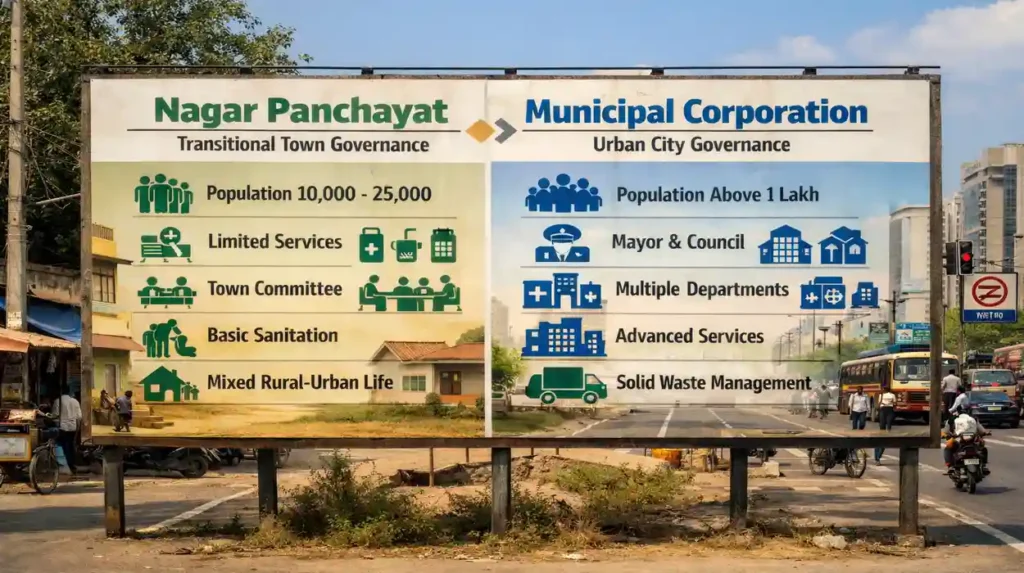
A Nagar Panchayat or Town Panchayat in some states, represents the smallest unit of urban governance in India. These bodies govern areas that are transitioning from rural to urban character. Typically, a Nagar Panchayat is established in settlements with populations between 11,000 and 25,000, though these figures may vary across different states.
Nagar Panchayats are created in areas where urbanization is in its early stages. These settlements exhibit characteristics of both rural and urban environments, with a significant portion of the population still engaged in agricultural activities while urban amenities and infrastructure are gradually developing.
Administrative Structure
The administrative structure of a Nagar Panchayat is relatively simple compared to larger urban bodies. It consists of elected representatives called ward members or councilors, who are chosen through direct elections. The head of a Nagar Panchayat is typically called the Chairman or President, elected either directly by the people or indirectly by the elected members.
The number of elected representatives in a Nagar Panchayat usually ranges from 10 to 15, depending on the population and geographic area. The state government appoints an Executive Officer or Secretary to assist in day-to-day administrative functions and implement decisions taken by the elected body.
Functions and Responsibilities
Nagar Panchayats handle basic civic functions including street lighting, drainage maintenance, solid waste management, and water supply. They also oversee the construction and maintenance of community facilities like markets, dharamshalas, and cremation grounds. Public health measures, including sanitation and prevention of epidemic diseases, fall under their purview.
However, compared to Municipalities and Municipal Corporations, Nagar Panchayats have limited financial resources and technical expertise. They often depend heavily on state government grants and assistance for implementing development projects and delivering services efficiently.
Municipality: Managing Medium-Sized Urban Centers
Definition and Coverage
A Municipality, also called a Municipal Council or Nagar Palika, governs medium-sized urban areas with populations typically ranging from 25,000 to 100,000, though larger towns may also be classified as Municipalities depending on state-specific criteria. These urban centers have more developed infrastructure, higher population density, and greater economic activity compared to areas under Nagar Panchayats.
Municipalities serve as the middle tier in India’s urban governance structure, bridging the gap between small transitional towns and large metropolitan cities. They are established in district headquarters, important commercial towns, and urban areas with substantial non-agricultural economic activities.
Organizational Framework
The organizational structure of a Municipality is more elaborate than that of a Nagar Panchayat. It comprises elected councilors representing different wards within the municipal area. The number of councilors typically ranges from 15 to 40, depending on the population size and the number of wards.
The head of a Municipality is known as the Municipal President, Chairman, or Mayor, depending on the state. In some states, the head is directly elected by the people, while in others, councilors elect the head from among themselves. The state government appoints a Chief Executive Officer or Municipal Commissioner to handle administrative matters and ensure proper implementation of municipal decisions.
Powers and Functions
Municipalities possess broader powers and responsibilities compared to Nagar Panchayats. They manage urban planning and regulation, including building permission and development control. Public health services, including running dispensaries and maintaining maternity homes, are important municipal functions.
Municipalities maintain roads, bridges, and public spaces, and are responsible for street lighting, water supply systems, and sewerage networks. They regulate markets, collect various taxes and fees, and implement poverty alleviation programs. Fire services, public libraries, and regulation of slaughterhouses also fall under municipal jurisdiction.
Financially, Municipalities have greater revenue-generating capacity through property taxes, water charges, commercial licensing fees, and advertisement taxes. However, they still rely partially on state government grants for major infrastructure projects and welfare schemes.
Municipal Corporation: Governing Major Cities
Definition and Scope
A Municipal Corporation, also known as Mahanagar Palika, represents the highest tier of urban local governance in India. These bodies are established in large cities with populations exceeding 100,000, though many Municipal Corporations govern cities with millions of residents. Metropolitan areas like Mumbai, Delhi, Kolkata, Chennai, Bangalore, and Hyderabad are administered by Municipal Corporations.
Municipal Corporations possess the most extensive powers, largest financial resources, and most complex administrative machinery among all urban local bodies. They are established through specific state legislation and operate under separate Municipal Corporation Acts rather than the general municipal laws applicable to smaller urban bodies.
Administrative Architecture
The administrative structure of a Municipal Corporation is highly sophisticated and hierarchical. It consists of directly elected councilors representing various wards across the city. Large Municipal Corporations may have 50 to over 200 councilors, depending on the city’s size and population distribution.
The head of a Municipal Corporation is called the Mayor, who may be directly elected by citizens or indirectly elected by councilors, depending on state provisions. The Mayor primarily serves a ceremonial and representative role, presiding over council meetings and representing the city at official functions.
The real executive authority rests with the Municipal Commissioner, a senior Indian Administrative Service (IAS) officer appointed by the state government. The Commissioner heads the administrative apparatus, supervises municipal employees, implements council decisions, and ensures service delivery across the city.
Municipal Corporations have multiple specialized departments handling specific functions like engineering, health, education, finance, town planning, and property assessment. Each department is headed by a departmental head or deputy commissioner, creating a comprehensive administrative framework.
Extensive Functions and Autonomy
Municipal Corporations exercise the widest range of functions among all urban local bodies. They handle complex urban planning, including preparation of master plans and zoning regulations. They maintain extensive road networks, flyovers, bridges, and public transportation infrastructure.
Corporations run hospitals, dispensaries, schools, and colleges. They manage large-scale water supply projects, sewerage treatment plants, and solid waste management systems. Fire services, disaster management, environmental protection, and pollution control are important municipal functions.
Municipal Corporations regulate construction activities through building permits and development controls. They maintain parks, gardens, playgrounds, and cultural facilities. Urban poverty alleviation, slum improvement, and affordable housing schemes are also implemented by these bodies.
Financially, Municipal Corporations have substantial autonomy and revenue-generating capacity. They collect property taxes, professional taxes, entertainment taxes, and various user charges. They can also raise loans and float municipal bonds for funding infrastructure projects, giving them greater financial independence compared to smaller urban bodies.
Key Differences Between Nagar Panchayats, Municipalities & Municipal Corporations Summarized
The fundamental difference between these three urban local bodies lies in the size of the population they serve and the complexity of governance required. Nagar Panchayats serve small transitional towns, Municipalities govern medium-sized urban centers, and Municipal Corporations administer large metropolitan cities.
Administrative complexity increases progressively from Nagar Panchayats to Municipal Corporations. While Nagar Panchayats have simple structures with limited staff, Municipal Corporations employ thousands of personnel across multiple specialized departments.
Financial capacity and autonomy also vary significantly. Nagar Panchayats have limited revenue sources and depend heavily on state grants. Municipalities have moderate financial independence with diversified revenue streams. Municipal Corporations possess substantial financial autonomy, extensive revenue-generating powers, and capacity to raise market loans.
The range of functions and service delivery responsibilities expands from basic civic amenities in Nagar Panchayats to comprehensive urban services in Municipal Corporations. Similarly, the technical expertise, infrastructure management capabilities, and planning sophistication increase with the size and complexity of the urban body.