Afzalpur is a small town in the northwestern part of Karnataka, but it has a long and rich history. It is located in Kalaburagi district, about 61 kilometres from the district headquarters. The town serves as the centre of Afzalpur taluk and lies at an elevation of around 408 metres above sea level. The surrounding area is part of the Deccan plateau, with dry and open land. Rivers pass through the region, and traces of old dynasties can still be seen today.
The Name and Its Origins
The town did not get its name by accident. It derives its name from Afzal Khan, a powerful commander of the Adil Shahi dynasty of Bijapur, who is believed to have had strong connections to this locality. Afzal Khan served the Adil Shahi dynasty of Bijapur Sultanate and played an important role in the southern expansion of the kingdom by subjugating Nayaka chiefs who had taken control of the former Vijayanagara territory. His reputation across the Deccan was enormous. In 1659, the Bijapur government sent Afzal Khan to subjugate Shivaji, a former vassal turned rebel. He was killed at a truce negotiation meeting with Shivaji, and his army was defeated at the Battle of Pratapgad. That campaign ended his life, but his name lived on. This town in Karnataka still carries it.
Location of Afzalpur Town
The location of Afzalpur is worth understanding. The Afzalpur taluk borders the Aland taluk to the north, the Kalaburagi taluk to the east, the Jevargi and Sindgi taluks to the south, the Indi taluk of Vijayapura district to the west, and the Akalkot taluk of Maharashtra’s Solapur district to the northwest. The town sits right at the crossroads of Karnataka and Maharashtra. People, trade, and culture have moved through here for centuries. That cross-border position has given Afzalpur a distinct character. It is neither fully south nor entirely west. It belongs to a middle zone where languages blend and histories overlap.
The Bhima and Amarja rivers flow through this taluk. These are not minor streams. The Bhima is a major river of the Deccan, and its presence near Afzalpur has shaped both agriculture and religious life in the region. The confluence of the Bhima and Amarja is considered sacred by many who live here.
Afzalpur, A Town Built on Ancient Layers
The history of Afzalpurdoes not begin with the Adil Shahis. Afzalpur’s history dates back centuries, with evidence of human habitation found in archaeological sites in and around the town. The region has been influenced by various dynasties and empires, including the Rashtrakutas, Chalukyas, and Bahmani Sultanate, each leaving behind traces of their architectural and cultural legacy.
Each dynasty that passed through left something behind. The Chalukyas brought temple traditions. The Bahmani Sultanate brought Islamic culture and trade links. Then the Adil Shahis arrived from Bijapur and left the most visible mark. Their architecture is still standing today. Their commander’s name is still on the town’s signboards.
The Mosque and Heritage Landmarks
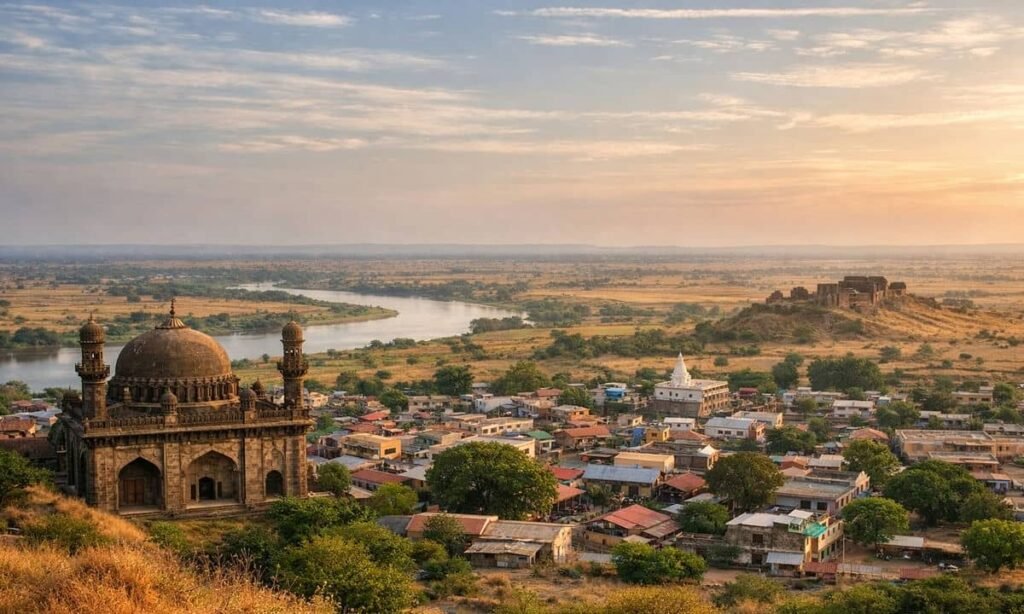
The most prominent physical reminder of Afzalpur’s past is its mosque, associated with the Adil Shahi era. The Afzal Khan Mosque was constructed in 1652 AD during the Adil Shahi dynasty and stands as an example of Indo-Islamic architecture in the region. It is one of several heritage structures in and around the taluk that reflect the layered Islamic and Hindu influences of the medieval Deccan.
Nearby, in Chinamalli village about 38 kilometres away, the 12th-century Mallikarjun Temple was built in the Kalyana Chalukya style and overlooks the Bhima River, serving as a significant Shiva shrine with historical ties to medieval Deccan rulers. These sites together give a sense of how many centuries and how many faiths have left their mark on this corner of Karnataka.
The area around Afzalpur also contains spots in Udachan and Atanur that reflect the taluk’s layered Islamic and Hindu past, though many of these sites remain under-documented and deserve closer scholarly attention.
The Sacred Site at Ganagapur
Beyond the town itself, Afzalpur taluk contains one of the most important pilgrimage sites in the entire region. Ganagapur, situated on the banks of the Bhima River in Afzalpur taluk, is renowned for the Shri Kshetra Ganagapur Dattatreya Temple, a key pilgrimage site associated with Lord Dattatreya and the 14th-century saint Sri Narasimha Saraswati. The temple complex, including the Nirguna Math with sacred padukas, underscores the area’s Datta sampradaya traditions and attracts thousands of pilgrims annually.
The famous Dattatreya Temple is being considered for redevelopment on the lines of the Kashi Vishwanath Temple Corridor, with proposed assistance from both central and state governments. This would be a significant development for the region. The temple already draws large crowds, particularly on auspicious occasions like Datta Jayanti. The local MLA has also proposed establishing a heliport at Deval Ganagapur to improve connectivity for devotees visiting from distant places. Better infrastructure could transform it into one of the more prominent religious destinations in northern Karnataka.
Population of Afzalpur
As of the 2011 census, Afzalpur Town Panchayat has a population of 27,088, of which 13,892 are males and 13,196 are females. The town has grown since then, though an updated official census figure is not yet available. The ward count and administrative boundaries of the town have also seen changes over the years as the civic body was upgraded, and the area under municipal administration now covers more ground than the older census-era town limits suggest.
The community is genuinely mixed. About 75.95 percent of the population is Hindu and 23.56 percent is Muslim. Smaller communities of Christians, Buddhists, and Jains are also present. Languages follow a similar pattern. Kannada is the main language of daily life, but Urdu has a strong presence among the Muslim population, and Hindi is also spoken. This linguistic mixture reflects the town’s position between linguistic zones.
Scheduled Castes make up about 20.9 percent of the population, and Scheduled Tribes account for 0.57 percent. These communities are central to the social fabric of the town and the surrounding villages.
Literacy and Education Profile of Afzalpur
The literacy rate in Afzalpur is 69.68 percent, which is below the Karnataka state average of 75.36 percent. Male literacy stands at around 76.87 percent, while female literacy is 62.15 percent. The gap between male and female literacy is a challenge the town shares with many smaller Indian urban centres. It reflects older patterns of access that are slowly changing.
The town has a Government First Grade Degree College located on Gattargi Road on a spacious campus of nearly 5 acres, offering arts and science courses. Outstation students are provided with government hostel accommodation. The college sits on the edge of town where the landscape opens up and the hills provide a green backdrop. It is the main centre for higher education in the area, drawing students from the surrounding villages of the taluk.
Schools, both government and private, serve the town’s children at primary and secondary levels. The presence of these institutions is important in a region where educational access has historically been uneven.
Agriculture and the Local Economy
Afzalpur has a particular reputation in the state for producing high-quality sugarcane. Sugarcane is the backbone of the local agricultural economy. The flat black soil of this part of the Deccan is well suited to it. Fields of tall cane are a common sight on the roads leading into and out of town.
Of the total population, about 9,676 people were engaged in work or business activity at the time of the 2011 census, with 6,874 males and 2,802 females in the workforce. Agriculture employs the largest share. But small trade, services, and government employment also contribute. The taluk has a substantial number of villages spread across its territory, and the town serves as the commercial and administrative hub for all of them. Farmers come here to sell produce, buy supplies, and access government offices.
Governance and Administration
Afzalpur is the seat of the Afzalpur taluk administration. The Town Municipal Council is located on Bazar Road in the centre of town and oversees local civic functions including water supply, roads, and sanitation. The taluk office handles revenue, land records, and other administrative matters for the surrounding area. The civic body has evolved over time and its current jurisdiction covers a broader urban area than the older town panchayat limits recorded in census data.
The town provides a range of government services to its residents, including veterinary facilities, a public degree college, and model primary schools, all of which serve the wider taluk population beyond the town itself.
Historic Importance of Afzalpur Town of Karnataka
Afzalpur is not a famous place. It does not appear in most travel guides. Tourists rarely stop here on their way between Kalaburagi and Bijapur. But that is part of what makes it worth understanding. It holds a mosque from the age of the Adil Shahis. It sits beside rivers that pilgrims have walked to for centuries. Its name belongs to a warrior-general who changed the course of Deccan history. Its fields produce sugarcane that supplies mills across the region. Its residents speak Kannada, Urdu, and Hindi in the same street.